
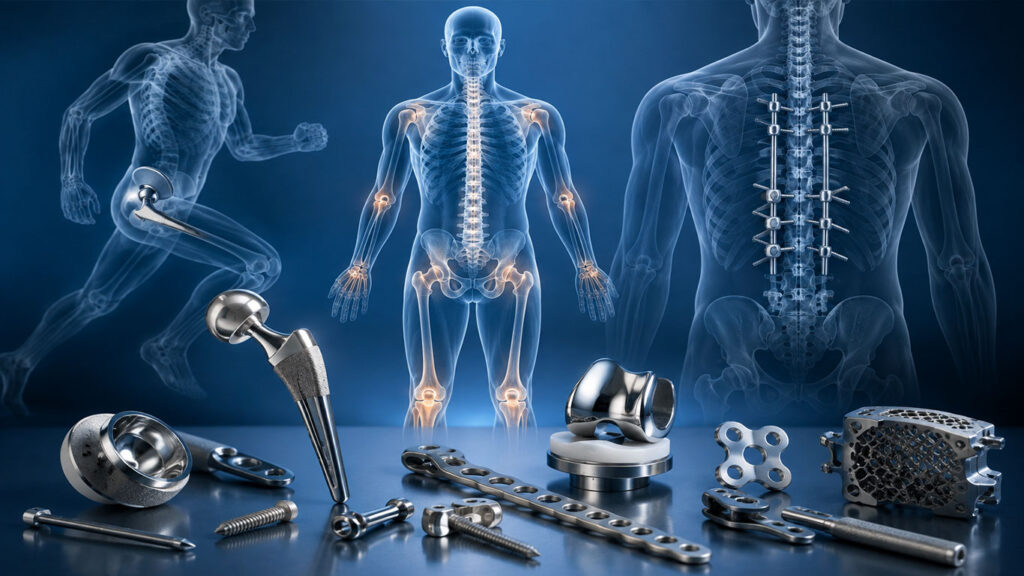
What are titanium implants?
Today, most implant systems used in modern surgical procedures are manufactured from titanium alloys. Titanium is particularly preferred in orthopedic implants, craniomaxillofacial implants, neurosurgical implants, and veterinary orthopedic implant systems.
Titanium implants are confidently preferred by both surgeons and manufacturers due to their high durability, biocompatibility, and long service life.
What are the advantages of titanium implants?
The compatibility of materials used in the production of medical implants with the human body is of critical importance. Thanks to its physical and biological properties, titanium is one of the metals that meets these requirements at the highest level.
1. Provides High Biocompatibility
One of the most important advantages of titanium is its high tolerance by the human body. Thanks to its biocompatibility, it works in harmony with body tissues and helps the implant to be used safely for a long time.
This feature is particularly important in bone fixation systems, plates, screws, and reconstructive implants.
2. Offers High Durability and Strength
Titanium alloys provide reliable performance in implant systems requiring long-term use, thanks to their high mechanical strength.
The ability of implants to withstand the loads they are subjected to during the bone healing process is a crucial element of surgical success.
3. It has a lightweight structure.
Titanium is a remarkably lightweight metal despite its durability. This property enhances the comfort of using implants and provides significant advantages in surgical applications.
The combination of high strength and low weight makes titanium a unique material in the medical sector.
4. It is resistant to corrosion.
The human body is a highly complex and challenging biological environment. Titanium, thanks to its natural surface structure, exhibits high resistance to corrosion.
This feature helps implants maintain their structural integrity for many years, increasing product reliability.
5. Provides long-lasting use.
Titanium implants offer the advantage of long-term use thanks to their combination of durability and biocompatibility. This positively impacts both patient satisfaction and treatment success.
In which fields are titanium implants used?
Today, titanium implant systems are used in many different surgical specialties.
Its main areas of application are:
● Neurosurgical implant systems
● Craniomaxillofacial (CMF) implant systems
● Hand and foot surgery implants
● Thoracic surgery implants
● Trauma and orthopedic applications
● Veterinary orthopedic implant systems
● Reconstructive surgical procedures
This wide range of applications highlights the importance and reliability of titanium in the medical sector.
Why is precision important in titanium implant manufacturing?
The success of an implant depends not only on the materials used but also on the quality of its production. In particular, titanium implant production requires processing technologies that demand micron-level precision.
Advanced CNC manufacturing systems, quality control processes, and surface treatment technologies optimize the geometric accuracy and performance of implants.
Quality control checks are carried out during the production process;
● Maintaining dimensional accuracy,
● Increasing product reliability,
● Ensuring surgical compliance,
● It ensures long-lasting performance.
Therefore, advanced engineering infrastructure and quality management systems are of great importance in the production of titanium implants.
Ramed Medical ‘s Titanium Implant Manufacturing Approach
At Ramed Medical, we utilize advanced manufacturing technologies in the development and production of titanium implant systems, which require high precision.
We manufacture implant systems used in neurosurgery, craniomaxillofacial surgery, thoracic surgery, hand and foot reconstruction, and veterinary orthopedics, with a focus on quality, reliability, and precision.
Thanks to our production processes carried out in accordance with the ISO 13485 quality management system, we continuously improve the compliance of our products with international quality standards.
Conclusion
Titanium implants form the basis of modern medical implant technologies thanks to their superior properties such as high biocompatibility, durability, lightness, and corrosion resistance.
These properties, which support surgical success, have made titanium an indispensable material in many fields such as orthopedics, neurosurgery, CMF, and veterinary orthopedics. Advanced engineering and quality management systems used in titanium implant production further enhance the reliability and performance of these products.